Pages

December 19, 2006

Feeling Froggy? Jump!

Crouched in the door of the Twin Otter, waiting for the signal to jump, I see Zicatela Beach 15,000 feet below me, patiently awaiting my return. In just six short minutes, I'll set myself down softly on the hot white sand.

The yellow light comes on: “Door!” a chorus of voices shout in unison. We roll it open, and the rush of air almost sends me backwards. We check our spot, tentatively hanging out the door, fingers clasping the bar running horizontally above the doorway, and looking down at the beach, hearing nothing over the whine of the turbines and screaming wind.

Green light: “Go!” the same choir sings from the front of the plane. An instructor grins and gives us the thumbs up, refraining this time from just pushing us out the door because he knows we are working on exiting together. With very few jumps—around 100 apiece—we are definitely amateurs. I silently thank him for letting us leave at our own pace.

Facing each other, I wait for the signal from Jeanne. My eyes never leaving hers, I read her lips as she screams “Ready, Set, Go”. My timing is critical here: if I don’t leave at the same time as she does, we will separate and probably never see each other again in freefall.

We are out the door on the word go, amazingly in sync. She is holding on to my chest strap, and I am screaming in disbelief that we did not separate while exiting the plane. Grinning from ear to ear, we slowly spin then correct it, flying closely, on our bellies, faces two inches apart. Altimeter check: 12,000 feet above sea level. She lets go of my chest strap, and finds my elbows.

Moving at a speed of 120 mph in freefall, we are flying. The air is our medium, a substance not unlike water: flowing, conforming, and moving. It is alive, and we move through it. Dancing in the air, it can be as graceful as the most beautiful ballet. Movement is choreographed, rehearsed on the ground then performed in the air. There is no time to think, as the seconds fly by. You have to permit your body to move, to react and let muscle memory guide you in your routine. We separate, and then find each other again, working on trying to stay on the same level while trying not to spin, not to slide backwards. It is about control, but also very much about letting go. Relaxing, letting the air do the work. A metaphor for life, skydiving is about maintaining some control in an out of control situation: falling from a plane 2.5 miles above the ground. You have to be in control, and first and foremost, be responsible for yourself, yet aware enough to work with others in the air as the earth rushes toward you.

It is also about living in the moment. Nothing exists when you are in freefall, only you, your partner and the jump you planned to do. It is somewhat like a form of meditation. Your mind is free, because it has to be. Your body knows what it needs to do, because you are following the routine decided upon before you even put the parachute on your back. It is this surrender to muscle memory and a free mind that allows your body to submit and follow the path of least resistance. And it is amazingly easy, uncomplicated and uncluttered by too much mind. Without the worry of trivial, everyday things, like wondering what you’ll have for lunch or fretting over some foot-in-the-mouth moment you recently had. It is a true test of keeping it real.

We didn't practice the kiss on the ground. Around 7,000 feet, Jeanne leans over and gives me a kiss on the cheek. I laughed out loud, but surely she couldn't hear me. Or maybe she did.

At 5,500 feet—just under one minute of freefall—we wave goodbye, and turn in opposite directions to track away. Six seconds of flying like superman, me toward the land, she toward the sea. Fast and flat, straight legs and strong arms, my track was good this time and I covered some distance. I slow down, stabilize, then look around, wave off and then pull my parachute, flinging the pilot chute far and wide. As though my life depended on it: Because it did.

Then I arch, hard, with all my might, feeling like that if it weren’t for the bulky parachute covering my back, I could fold in half and break in two. I wait for the speed to change dramatically; wait to hear the delicious telltale 'swoosh' of the fabric as the cells of the canopy inflated, and then feel myself swing side to side as the parachute opened completely. I wait for 3 seconds, and then look up to see my opening. All clear—no twisted lines, no lines where they shouldn’t be, all nine cells inflated properly—so I reach for my steering toggles, release them and brake, pulling the lines down to my waist. I feel a slight lift; I am in a stall, the result of a full brake. Releasing them, the parachute dives down, the closest thing to falling that I’ll feel the entire skydive.

Full speed ahead, the canopy flies forward. Flying over the water, then over the town, looking down on cars and houses that grow bigger by the second, I can see everything literally from a bird’s eye view, yet somehow I always feel completely alone up there. No one can hear you, and the silence can be deafening. Sometimes I scream, hoot and holler, partly out of sheer exhilaration, and partly because it is a voice no one can hear and I like how it feels.

I am not yet that comfortable flying my parachute; with time and more jumps, a confidence will develop and I will become more adventurous. For now, I observe. I look around. I look at beautiful Mexico, I watch the surfers below me on the Mexican Pipeline, surfboards bright white and glistening in the midday sun. I see the Mexican flag—our larger than life wind sock—flying over Puerto Escondido, waving proudly in the coastal breeze.

I watch my canopy flying above me. The intricacies of a very precise but delicate system fascinate me: How this nearly transparent nylon and these thin strings can hold me up 3500' above the earth astonishes me. I am forever humble and respectful of this equipment. It saves my life every time I jump. Literally.

At 500' I turn and fly along the beach. I am over the rocks on the north end of the beach.. Everything from this altitude looks close, but in reality there is time. A little more precious time in the air to look at the people on the beach, watching us land our parachutes. I choose a spot near the water's edge. The sand here is cooler, wet from the receding tide. I see a group of people nearby, watching me, cameras pointing in my direction. In my periphery, the water blurs past, palapas, beach chairs, tourists follow. But it doesn't feel faster: time has slowed down, and I am focused on one spot right past a red flag stuck in the sand. In this moment, all that exists is that placet: I will get there, right where I want. Dead center.

Ten feet or so from the ground, I start braking, with both hands, starting slowly, then bringing them all the way down to my waist. I touch down, right foot first, soft as a feather in the forgiving sand. The left follows, my canopy falling behind, carried by the breeze. It falls to the beach, and let out my customary 'woo-hoo!’ The jump is over, but the feeling will last for hours, if not a lifetime.

Jeanne is waving at me, and I am jumping up and down, out of excitement for our jump together, and to ease the sting of the scorching sand. I am purely and utterly elated because it was successful, and completely amazed that I had just flung myself out of the door of an airplane three miles above the earth. That I had someone to share it with is the icing on an already delicious cake; someone who is living in exactly the same moment I am, without a doubt understanding it the same way I do.

We meet each other on the beach, canopies in hand, and enormous grins swallowing our faces. A big hug and a knowing glance later, we are planning our next jump, eagerly anticipating the next time we get to roll the door open, leap out of the plane and fly high above the earth, seeing Mexico—and everything else—from a fresh perspective. Knowing that, like every moment of every day, the next jump will be different, and better than the last.

November 8, 2006

On the Carribbean Side of Things

Though I´ve only been gone a week, I have a lot of stories to tell and have been taking copious amounts of notes. Venezuela has a lot to offer, including beaches on the Carribbean--my first visit ever to these seas.
Higuerote is about 1.5 hours east of Caracas, Venezuela's capital city and hub of business and just about everything else. For the most part, Caracas seemed nice enough; not too huge and sprawling due to topographic limitations. It lies in a valley in the coastal mountains, the highest peak around 2800 meters. A gondola runs from the city up to a high point on the ridge of green that lies due north of town, separating it from the Carribean. The ride is slow. Hovering over a dense jungle canopy, the suspended cage feels a bit claustrophic, vulnerable. At the high point of the gondola, where we were furthest from the tree tops and the anacondas and whatever else lie beneath, my friend Gustavo (Rifle [Reef-lay], nickname because he looks EXACTLY like an argentinian soccer player named Rifle) couldn't resist sussing out the possibility of jumping out of the gondala with a BASE jumping parachute on his back. Height: high enough. Landing zone: nada. Rescue potential: never. So that idea was out.
The summit of La Avila was beautiful. A bit developed, but what do you expect that close to a huge city. Even so, it was nice to look at the Carribbean to the north, city to the south. I was disappointed for the lack of access to hiking trails; surely there were tons, but we couldn't find anything but a road. I had jetlag anyway, so it wasn't the end of the world. Before going to the gondola, we had stopped by the Skydive Venezuela kiosk at the HUGE shopping center, and the woman staffing the booth, a Puerto Rican women named Maricarmen, had told us it would be cold up there: "te vas a congelar" (you are going to freeze). We were both sweating and laughing our asses off; I don't think she had probably EVER experienced cold.
One day in Caracas probably wasn't enough. Or maybe it was, depending on your point of view. That evening, my second in Venezuela, we left for the Drop Zone at the airport in Higuerote. The drive was long, lots of traffic on a Friday night. I was still recovering from 2 sleepless nights getting here, so I drifted in and out of sleep, waking and preferring not to see the road and huge trucks and cars coming at us so fast, happily closing my eyes in the back seat of Luis' jeep. Nobody drives crazier that Latin Americans: never in a hurry until they get behind the wheel. After all, it took us 5 hours to eat and get ready to go to Higuerote. "Unos minutos" (a few minutes) at Luis' house preparing for the trip turned into 2.5 hours. Not sure exactly what Luis was doing, besides packing a parachute in the living room. Rifle and I were entertained by Luis' mama. The discussion turned political; how could it not in Caracas one month before presidential elections? I felt a)ignorant of the Venezuelan political situation, and b) as always, somewhat ashamed to be an American. I have to say, there was some finger pointing going on because of the US's International, shall I say, 'behavior'. It was interesting to talk to Luis' Mama, a highly educated and affluent woman.
Once in Higuerote, arriving with only one near death incident, I was bowled over by the suffocating heat and humidity. It is situated right on the coast, beautiful. Frogs and toads, birds everywhere. Everything is lush and green; the landing zone soft and grassy, like a big park. And big. I am used to landing a parachute on the beach, having to navigate the obstacle course of Palapas, life guard towers, dogs, kids. Or in Cuautla in a tiny, hard as cement landing area where the soil is so dry, it is cracked, baked and the air is thin due to elevation so you come in fast and hard. Well I did anyway.
It was wonderful to be in the company of skydivers again. It feels somehow like home, even though I am hardly a skydiver. The vibe is just so good, easy and laid back, but there is so much passion for what they do. Everyone who works at the zone lives it, 24/7. It's pretty inspiring. Maybe not necessarily to be a full time enthusiast, or professional, but to find something you love so much you are willing to live in a dorm and own nothing but parachutes and cameras.
We jump out of the plane backwards. It is some kind of Russian thing with the exit in back, always open. As my friend Tris said, "It's a bit like diving into a pool doncha think?". Can't argue that. It was a bit scary, after not having jumped in a year and a half. Rifle was with me though, and it went really well. Freefall was amazing; I smiled the whole time, with him just hanging onto me with a pinky in case something should happen, although wanting to let me fly alone a couple of times, and giving me the thumbs up, saying "De Pinga (venezuelan for "Muy Bien")" more than once.
The weekends here are the busiest, with tandems and students taking the course to go solo. During the week there wasn't much happening so we ended up checking out the Carribean side of things, looking for clean beaches and respite from the oppressive heat. And now, being Friday, I think I could be missing out on jumps right now...don't want to miss the plane, unless it's the Cessna.
Unfortunately I don't have photos yet. I'll add them later.

Blue Malibu


Buses are hard to come by in Higuerote, so we usually travel by taxi. Gas in Venezuela is cheaper than drinking water ($2.00 to fill your tank) which makes the price of driving a car, and thus hiring a taxi, really inexpensive.
Because there was nothing going on at the drop zone today, we decided to try to find a clean beach to escape the oppresive heat. After some inquiries, we found out that there is a nice beach to the west of Higuerote, on the other side of the prominant point outside of town. To get there you have to take a taxi, then get on a little boat because there are no roads into the jungle that surrounds the beach. Sounded perfect, so we called up the Higuerote Taxi service from the DZ and waited for the ride to turn up. It was a big blue car, an old and worn Blue Malibu.
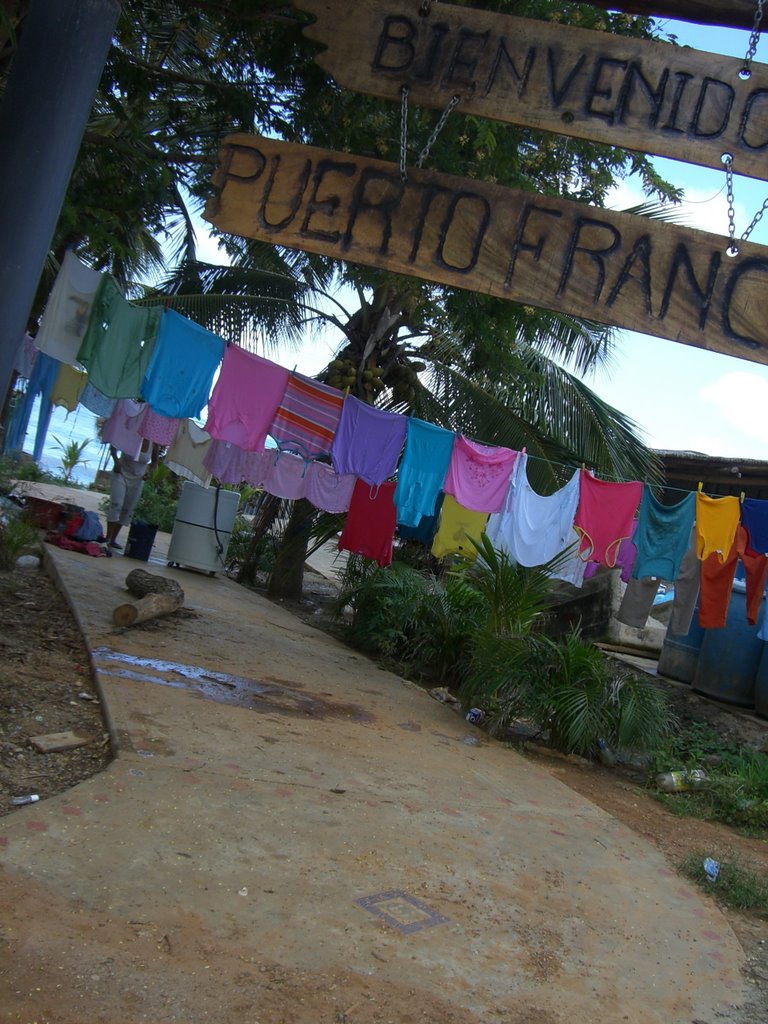
Cruising along, dodging kids, dogs, trucks, we were three: An Argentinian, a frenchman, and a gringa. Interesting combination for sure, the makings of a bad joke, the classic tri-national kind where something stupid is happening and one of the three turns out to be the dumbest of the lot. Puerto Frances, about which our Frances received some razzing, wasn´t a very long drive, even with a stop at the bakery for some breakfast, so before we knew it we were out of Higuerote cruising at breakneck speed along a windy jungle road.

Puerto Frances offered none of the excellent cheese and bread we were hoping for, but it was tranquilo and felt safe. We hoped to hire our boat there to ride to the other cleaner and less populated beach we could see off in the distance. Finding the dueƱo of the boat company (or the elder of the tribe as Gustavo the Argentinian called him)wasn´t hard. He was seated in the shade in a plastic lawn chair, belly big and full, hanging out of his t-shirt, looking as though he was waiting for something to happen: waiting for something and nothing, not bothered by much and certainly in no hurry to go anywhere at all.
And so the joke starts about now: frenchman, argentinian and a gringa are stuck in a small coastal village with nowhere to go because the boat couldn´t leave for the beach without 10 people on board. Unless we wanted to pay $25 apiece for the ride, which none of us were willing to do. After some time bargaining, we were able to get the price down a bit, but not enough. We decided to walk down the beach and see what it might have to offer. It was dirty, polluted, trash everywhere, nowhere you would like to spend the day.
After some time considering our options, and seeing that there were basically only two, we decided to talk with the elder again and accept his price. It was that or go back to Higuerote...and do what???
Finding the man again was easy, he hadn't moved an inch. We said ok, we would just pay the whole ticket if he could take us now. But he said no, 'el mar se pone mal' (the sea is getting bad)and refused to sail in those conditions; personally I couldn't see what he was talking about, but then again I am not a sea person. And so our minds were made up for us: back to Higuerote, which meant calling the taxi to come for us because no one was coming or going to Puerto Frances. We could wait for hours for a ride, maybe days.
Waiting for the taxi, the frenchman (ok his name is Juan) climbed a tree; I looked at plants growing among the trash alongside the road. Rifle sat on the side of the road swatting mosquitos, hoping they weren't carrying Dengue fever or something worse. We talked with a local man, waiting at the bus stop indefinitely for the colectivo to come. "When?", we asked. "Quien sabe?", he replied. So we offered him a ride in our taxi.
Once in the taxi, we decided to try going to a different beach that we saw along the way. Might as well, we were dying in the heat. Over the blaring music, we could sort of make out what the driver told us about having to take a boat to this other beach from a marina close to Higuerote. We stopped, the venezuelan got out; he would be the only one in this story who would make it where he wanted to be.
Arriving the marina, we were sent on a wild goose chase to find the right dock, with boats headed to Buche, our new goal. Just as we pulled up, a boat was leaving. Seeing us, the captain turned around and came back for us, and we quickly loaded the boat, "una lancha china (pronounced Chee-nuh)" our cabbie called it (a chinese boat, who knows what made it more chinese than any other boat) and sailed off to our new and hopefully cleaner retreat.
The ride was nice. Calm waters, the sea apparently hadn´t become too bad yet. As we rounded the point, we could see La Buche in the distance, and it looked ok. Coming closer, I started to feel like perhaps the joke really was on us, because as Rifle said so eloquently, it was "una mierda (a shithole)". And was it ever. The water was dirty, as a river ran into the sea right next to the beach. There were some beach front businesses, all boarded up apart from one, tired and dingy. It looked like no one ever came to Buche, and I was starting to think maybe I shouldn´t even get out of this Chinese boat.
But we did. Ultimately, we were thirsty. And hot, but honestly there was no way I was going to dip even a toe in that messy water: as Rifle put it, "you put your hand in whole, pull it out and it is just bones". Enough said.
The captain said he´d be back at 4:00. It was 11:30.
So we trundled away from the dock, me looking wistfully at the departing lancha, knowing we were screwed. But, keeping a positive attitude, I thought that there must be something we could do to entertain ourselves. Rifle was probably right when he said after 4 or 5 beers, this place might starting looking pretty nice; I couldn´t disagree, but also couldn´t bring myself to start drinking that early in the day, even out of sheer desperation.
There were other people on the "beach". A few random people, some with kids and grandma joining the joining the party. One family had even brought an inflatable pool with them, filled it with sea water and used it to corral the kids, keeping them out of trouble. In front of the restaurant (and I mean IN FRONT, feet up on the counter where you place your order), an obnoxious couple that had started the beer goggles solution, sucking down beers one after the other. The woman talked loudly on her cell phone, a cigarette in her hand. It was all very entertaining, but I was dying in the heat and needed shade. Away from this slihgtly dysfunctional beach scene.
We headed to a closed restaurant distant from the others. Rifle and Juan tried to take naps. I had heaps of energy, so I annoyingly reported the time every few minutes, which didn´t do much to alleviate the thought that we were stranded on a desert island, just like Gilligan and the gang. Then I started doing yoga on the sand. Juan said we could film it with his camera and maybe we could make a DVD: "Yoga in Paradise with Val", and make millions.
And so there we were, a Frenchman, an Argentinian, and a Gringa, stranded on a desert island. How much time could we waste here, doing nothing? Well, we could eat. A fishing boat had just pulled up, with the catch of the day in a 5 gallon bucket. So we went to the only open restaurant. I wasn´t hungry but I did drink a beer, as it was now 2:00, a more acceptable hour to start drinking. Rifle ordered shrimp, for $25,000 Bolivares (about $11.00 US), hoping they would be big and plentiful at that price. Either way, they were fresh. Juan ordered seafood soup, and I was put on patrol duty to watch for the Lancha china, in case enough people had showed up at the marina to warrant another journey over. There was no way the boat would be leaving without us.
Sure as Murphy´s Law would dictate, right when the eating had begun and we were finally doing something to distract ourselves, I saw a boat rounding the bend. Yep, that´s the China, I reported to the boys. Juan had just started eating a huge bowl of fish soup and Rifle´s wasn´t even done yet. I ran to the dock to hold the boat, while Rifle inquired about to go orders. I had my doubts on that one; either way, I was getting on that boat, without or without my multinational compadres.
The captain asked me if had paid, obviously thinking that I was one of the passengers just arriving. I explained that we wanted to leave early, and asked if he could wait for my friends for 5 minutes. He looked at me like I was crazy, probably wondering why on earth I would want to leave already. I said nothing in defense.
Finally Rifle and Juan came trotting down the beach toward the dock, Rifle carrying a to-go bag, and Juan carrying his bowl of soup on a plate. Apparently the restaurant agreed to let him take the dishes if the captain could bring them back on the next trip, which he reluctantly agreed to do.
And so we set sail. I felt like I was getting out of jail, even though I knew it hadn´t really been that terrible. Not my idea of a tropical paradise on the Carribean, but it could have been worse. We could have been stuck there until 4:00, roasting in the sweltering heat.
Juan and Rifle enjoyed their lunch on the bench of the boat, seated on the floor. As it turns out, Rifle´s shrimp were tiny and few, but delicious. He turned to me and said ¨Me rompio las pelotas (they broke my balls)", meaning he had been cheated. I looked at him amd thought to myself that actually we had all been cheated today, headed back to Higuerote, las pelotas having been busted in a big way. They asked me what we should do next, and I suggested we go to the hotel pool and cool off.
Four taxi rides, and one boat ride later, we were back where we started, enjoying the pure chlorinated waters of the Barlovento Hotel pool...tropical paradise, indeed.

April 11, 2006

Slimy Teeth


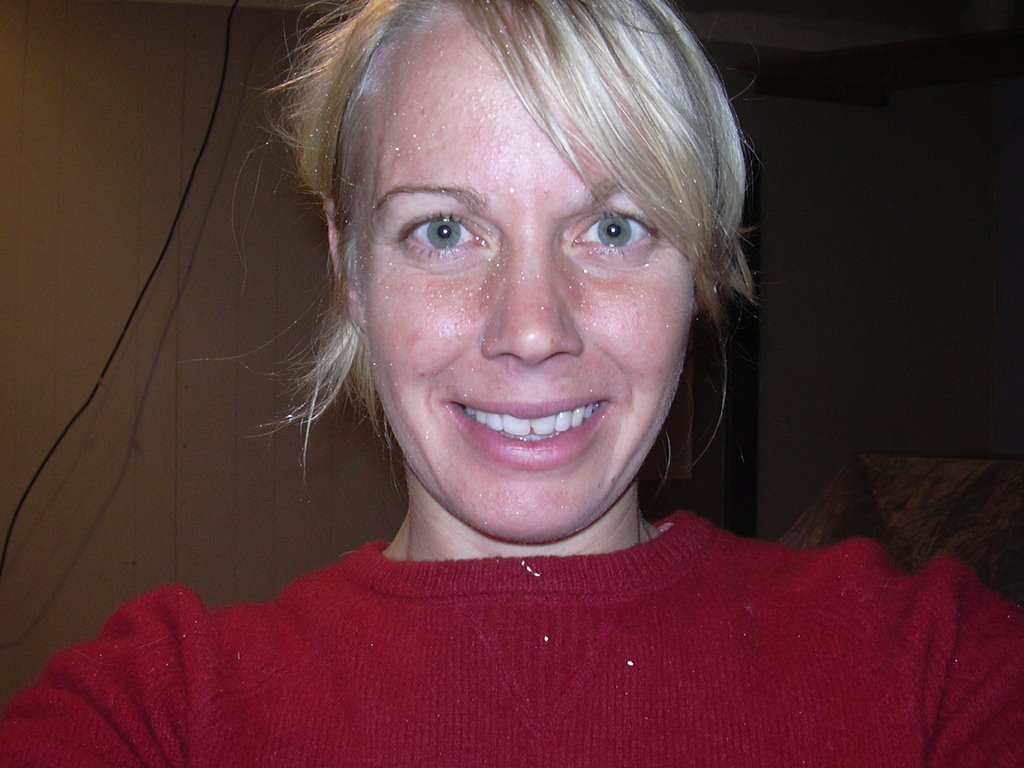
There aren't many photos of me on this blog, but here's what I look like with what I've taken to calling "new teeth".
They took my braces off about a week ago, and I'm still not used to how slimy my teeth feel, after years of having all that texture in my mouth. Still feels weird to be able to bite into an apple, and to eat without having to constantly pick food out of all that texture, to not rip the bristles of my toothbrush to shreds when I brush.